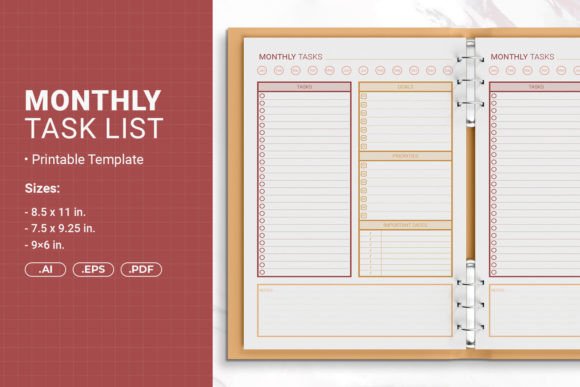
Monthly Task List Printable Template
If you’ve ever stared at a blank notebook page wondering where to start, or bounced between five different apps without ever finishing a to-do list, you already know the real problem isn’t motivation. It’s structure. A Monthly Task List Printable Template gives you that structure without asking you to learn new software, sign up for another subscription, or redesign your workflow from scratch. It’s a simple, professional, and adaptable tool that fits into how you already work, whether you’re planning content, managing a side hustle, or just trying to keep the household running without losing your mind.
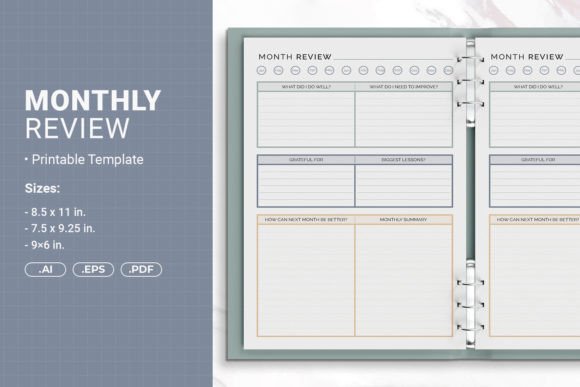
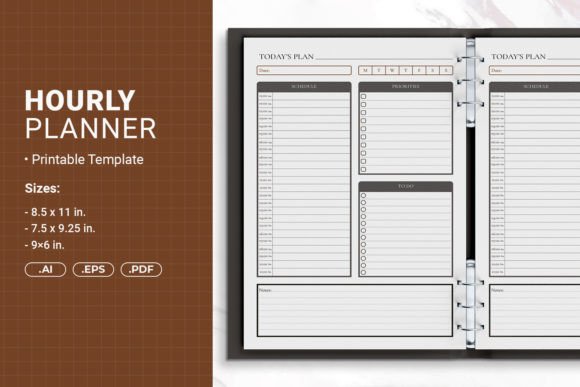
This particular template comes as an open-source package with AI, EPS, and PDF files, available in three sizes. That might sound technical, but what it means in practice is that you can use it exactly as it is, or tweak it until it feels like yours. Let’s walk through where this thing actually shows up in real life.
The everyday chaos that calls for a monthly task list
Most of us don’t need a complex project management system. We need a surface where we can see the whole month at a glance, drop in the recurring stuff, and still have room for the unexpected. That’s the sweet spot of a printable monthly task list. It’s not rigid. You can use it for work deadlines, personal goals, household chores, or all three on the same sheet.
Imagine a freelance graphic designer juggling three client projects, a newsletter, and a kid’s soccer schedule. A single monthly layout lets them block out delivery dates, mark invoice reminders, and note the days they absolutely cannot work late. No app can replicate the satisfaction of ticking off a paper checklist at the end of a long day.
For small business owners, the same template becomes a lightweight operations board. You can track inventory checks, social media posts, team check-ins, and bill payments without logging into anything. Print one for each month, pin it above your desk, and suddenly the fuzzy middle of the month comes into focus.
Three sizes, three distinct realities
The fact that this template comes in 8.5×11, 7.5×9.25, and 6×9 inches is not just a technical specification. Each size serves a different habit, workspace, or end product.
8.5×11 inches – the wall poster or binder powerhouse
This is the full-page size most people think of first. Slip it into a binder with safe margins for hole punch binding, and you’ve got a reusable monthly planner that sits open on your desk. If you’re a teacher mapping out lesson themes across a semester, a blogger scheduling editorial calendars, or a freelancer tracking pitch deadlines, this size gives you room to write without squinting. It also works great as a wall poster for shared spaces. A kitchen wall, an office corkboard, or a studio wall where everyone on the team can see what’s coming up.
7.5×9.25 inches – the portable sweet spot
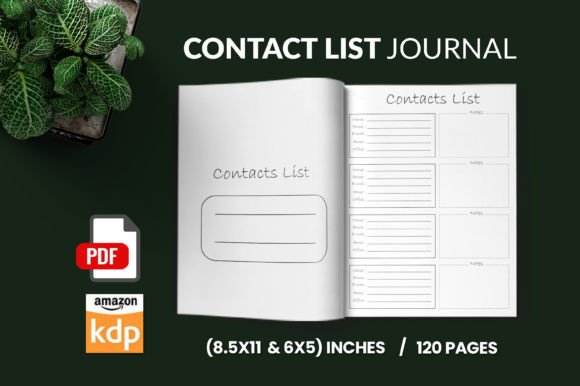
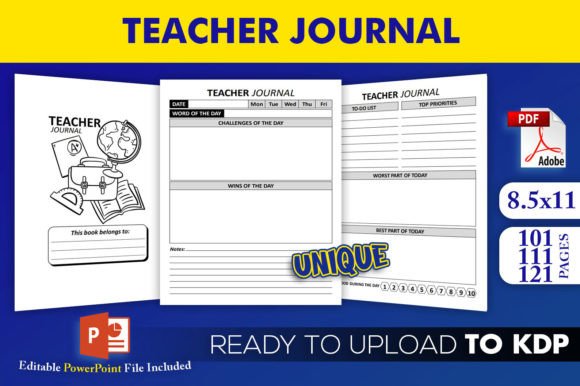
Slightly smaller than letter size, this format fits neatly into most bags without folding. If you’re a coach or consultant who moves between client meetings, coffee shops, and co-working spaces, this size tucks into a slim binder or a discbound notebook. You get the same layout but with less bulk. It’s also a popular choice for self-published planners. Because the template is ready for Amazon KDP PDF with bleed, you can upload it directly, add your own branding, and sell it as a physical product without rebuilding the design in a separate program.
6×9 inches – the notebook companion
This size is practically a standard for print-on-demand books and personal journals. Use it as an insert for a traveler’s notebook system or as a standalone booklet for a specific project. If you’re running a seasonal challenge in your online community, you can print a stack of these, bind them with a simple stapler or spiral, and hand them out to participants. The compact size encourages focus. You’re not staring at an overwhelming grid. You’re looking at a manageable list that fits one month and one context at a time.
Where people actually use this template
Let’s move beyond the obvious desk scenario. The beauty of a printable monthly task list is that it works in spaces where screens aren’t welcome, allowed, or practical.
- In the car. A parent who coordinates drop-offs, appointments, and meal prep can tape a 6×9 sheet to the dashboard or stash it in the glove compartment. It becomes the single source of truth for that month’s chaos.
- In a workshop or studio. Creatives who work with their hands, like potters, painters, or woodworkers, often keep paper nearby because screens get dirty or damaged. A monthly task list pinned above the workbench keeps production deadlines visible without interrupting flow.
- In a classroom or training room. Educators and trainers can use the template to map out course modules, assignment due dates, and review sessions. The absence of digital distractions helps them stay present with their students.
- In a retail or hospitality setting. Shift managers can print the 8.5×11 version, fill in staff schedules, cleaning rotations, and supplier deliveries, and post it in the back office. It’s readable, durable, and doesn’t require anyone to log into a shared calendar.
Customization without technical frustration
One of the strongest arguments for choosing an editable template over a static PDF or a pre-printed planner is control. You don’t have to accept a layout that almost works. The included AI and EPS files mean you can open the design in Illustrator, change colors, move sections, add your logo, or adjust spacing. If you sell digital products, this is a huge advantage. You can create multiple variations, a minimalist version, a colorful version, a version with motivational quotes, all from one base template.
For someone who isn’t a designer, the PDF files are ready to print as-is. That’s the safety net. You don’t need to touch the source files unless you want to. But having them available means you never hit a wall when you realize you need a slightly different column or an extra checkbox.
What to think about before you print or publish
Every tool has a context where it shines and a context where it frustrates. This template works best when you have clear monthly priorities. If your life is completely unpredictable from day to day, you might need a weekly layout instead. That’s not a flaw in the template. It’s a reminder to match the tool to the rhythm of your work or life.
If you’re planning to upload to Amazon KDP, make sure you understand bleed requirements. The template is prepped for it, which saves you from the common headache of sending a file to print and discovering the edges get cut off. But always check your specific platform’s specs. Different printers have slightly different tolerances.
Also consider the paper you use. For a binder that gets flipped open and closed all month, choose a heavier weight. If you’re printing a bulk order for a workshop or a product launch, a standard 20 lb paper keeps costs low and still feels professional. You can also laminate a few copies and use dry erase markers for a reusable calendar that survives coffee spills and marker smudges.
Why this template works for publishers and creators
Self-publishing is a lonely business, especially when you’re doing the design, formatting, and marketing yourself. A template that’s print-ready and bleed-compliant removes one of the most tedious technical hurdles. You don’t have to guess whether your margins are correct or worry about your PDF failing Amazon’s validation. That kind of reliability matters when you’re trying to move from idea to product without wasting weeks on formatting.
For bloggers and content creators, the same template works as a lead magnet. Offer it as a free download in exchange for an email address, and you’ve given your audience something genuinely useful. People don’t unsubscribe from a list that delivers tools they actually pull out and use. And because the template comes in three sizes, you can attract a broader audience. Some people want a desk-sized planner. Others want a pocket-sized insert. You cover both with one asset.
Small details that make a daily difference
There is something quietly powerful about writing down your tasks for the month on paper that looks and feels intentional. The safe margin for hole punching isn’t just a technical spec. It means you can bind this template without losing text. The three size options aren’t just numbers. They reflect how differently we move through our days. The open-source files aren’t just a bonus. They are an invitation to make the tool yours.
Whether you are a freelancer mapping out deadlines, a parent coordinating appointments, a teacher planning lessons, or an entrepreneur building a product line, a Monthly Task List Printable Template can adapt to your context rather than forcing you to adapt to it. That is the whole point. A good template disappears into your workflow. It doesn’t announce itself. It just makes the month a little bit clearer, one task at a time.