Hourly Planner Printable Template: A Practical Guide for Self-Publishers and Creators
Creating a professional-looking book from scratch can be a complex process, especially when you need to balance design flexibility with print-ready precision. For self-publishing authors, small business owners, and productivity enthusiasts, the Hourly Planner Printable Template offers a structured yet customizable foundation. This article provides an objective evaluation of what this template offers, how it performs in real-world scenarios, and practical guidance to help you decide if it aligns with your project goals.
What Is the Hourly Planner Printable Template?
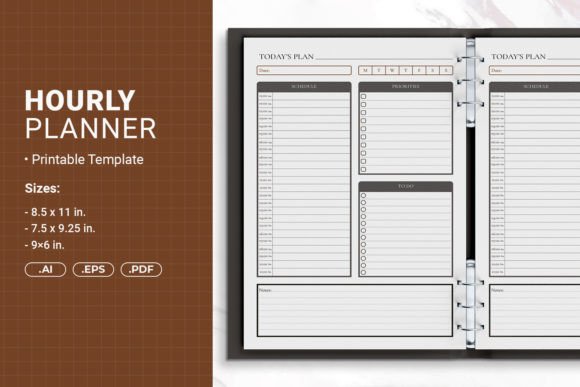
The Hourly Planner Printable Template is a digital design file package that provides a complete layout framework for creating hourly planner books, inserts, or binders. Rather than a pre-designed, content-filled planner, this template gives you the structural skeleton—the layout grids, hourly time slots, and spacing—that you can customize with your own colors, fonts, branding, or decorative elements. The template is built for both digital printing and upload to platforms like Amazon KDP, making it a dual-purpose tool for print-on-demand authors and DIY print users alike.
The package includes three file formats: Adobe Illustrator (AI) open-source files, EPS files, and PDF files. It comes in three standard sizes: 8.5 x 11 inches (215.9 x 279.4 mm), 7.5 x 9.25 inches (190.5 x 234.95 mm), and 6 x 9 inches (152.4 x 228.6 mm). Each size is ready for print with bleed, and the layout includes a safe margin for hole-punch binding, which makes it equally viable for three-ring binders, spiral binding, or perfect binding.
Why This Template Attracts Self-Publishers and Creators
There are several practical reasons someone might consider the Hourly Planner Printable Template over building a layout from scratch or using a generic design tool.
- Time savings without sacrificing flexibility. Creating a printable hourly planner from zero requires setting up margins, columns, hourly dividers, and bleed lines. This template eliminates that repetitive work while leaving design control in your hands.
- Multi-format compatibility. The inclusion of AI, EPS, and PDF files means you can work in vector editing software (Illustrator, Affinity Designer, CorelDRAW) or use the PDF directly for quick printing.
- Three size options in one purchase. Instead of buying separate templates for different trim sizes, you get three commonly used dimensions—covering everything from a compact 6x9 book to a full-letter-size 8.5x11 binder insert.
- Ready for Amazon KDP. The PDF file includes bleed, which is a non-negotiable requirement for KDP print-on-demand. This removes a common stumbling block for first-time self-publishers.
- Binding flexibility. The safe margin for hole punching means you can use the same layout for coil-bound, ring-bound, or sleeve-protected pages without content getting clipped.
Benefits, Tradeoffs, and Key Considerations
While the template offers clear advantages, a balanced evaluation requires looking at both its strengths and its limitations.
Benefits
- Professional layout structure. The hourly grid, margins, and spacing are pre-set to industry standards, so your final product looks clean and polished with minimal adjustment.
- Open-source AI files. Because the AI files are open source, you have unrestricted access to edit every element—change colors, move grid lines, add logo sections, or insert your own typography. This is a significant advantage over locked or image-only templates.
- Print-ready PDFs. For users who do not own design software, the PDF file can be used directly. You can open it in free programs like Adobe Acrobat Reader, add text boxes over the grid, and print with confidence that the bleed and trim marks are correct.
- Versatile across use cases. Whether you need a daily hourly planner for a time management book, a weekly hourly spread for a academic planner, or a custom insert for a binder system, the base layout supports all these scenarios.
Tradeoffs
- Requires software access for full customization. To take advantage of the AI or EPS files, you need vector editing software. If you do not own Adobe Illustrator or an alternative, your customization options are limited to what can be done with PDF annotation tools.
- No pre-filled content. This is a template, not a complete planner. You will need to add your own content—whether that is appointment slots, goal sections, or decorative elements. For someone expecting a fill-in-the-blank ready planner, this may feel like more work than anticipated.
- Learning curve for first-time users. If you are new to bleed margins, trim lines, or safe zones, you might need to spend time understanding how to use the template correctly, especially for KDP uploads. The package does not include a tutorial guide, though the layout is standard enough that most users can figure it out with basic knowledge.
- Limited to hourly layout structure. The template is specifically designed for hourly time-blocking. If your project requires a daily schedule with half-hour increments, or a combined to-do list plus hourly layout, you would need to modify the grid manually.
Considerations Before You Buy
File format compatibility: Check that the AI file version is compatible with your software. Older versions of Illustrator may not open newer AI files without conversion. EPS files offer a reliable fallback across many programs.
Size selection: The 6x9 size is ideal for trade paperbacks on KDP, while 8.5x11 is better for binders or coil-bound workbooks. The 7.5x9.25 size is less common but gives a slightly larger page than 6x9 while still being compact. Decide based on your target audience and distribution method.
Print testing: Even with bleed included, always print a single test page on your home printer or through a print-on-demand proof before finalizing a run. Check that the hole-punch margin is sufficient for your binding method.
Scenarios Where the Template Is a Strong Fit
The Hourly Planner Printable Template works best in situations where you have some design experience or are willing to learn basic layout principles, and you want to create a time-management product that looks custom-made.
- Self-publishing authors creating productivity books. If you want to publish a paperback or hardcover hourly planner on Amazon KDP, this template gives you KDP-compliant files out of the box. You can customize the cover and interior elements, then upload without fear of trim or bleed errors.
- Binder system users. People who use personal binders for time management (e.g., ring-bound A4 or letter-size systems) will appreciate the pre-placed hole-punch margin. You can print on standard paper, punch the holes, and insert the pages without content being lost in the binding holes.
- Small businesses or Etsy sellers. If you sell printable planner inserts or digital downloads, the three sizes let you offer options to different customers. The open-source AI files make it easy to create a branded product line with consistent layout across sizes.
- Educators and workshop facilitators. An hourly planner can be repurposed as a class schedule, time management handout, or workshop workbook. The flexible format allows you to add your own headers, instructions, or exercises.
When Alternatives Might Be Worth Considering
No single template suits every project. Here are situations where you might be better served by a different solution.
- You need a fully designed, ready-to-print planner with no customization. If your goal is to simply download, print, and use a planner immediately, a pre-filled hourly planner with decorative borders, pre-printed dates, and graphics might be more efficient. The Hourly Planner Printable Template requires you to invest time in design and content creation.
- You do not have access to vector editing software and prefer to work in Canva or other browser-based tools. While you can use the PDF file, you cannot edit the grid lines or layout structure without vector software. A Canva-compatible hourly planner template may be more accessible.
- You need half-hour or 15-minute increments. The template is designed for hourly blocks. If your schedule tracking requires more granular intervals, you would need to modify the grid extensively, which may be more trouble than starting from a custom layout.
- You want a complete interior ready for KDP with no modifications. If you prefer to publish a planner without any design involvement, there are pre-made KDP interiors available that include headings, dates, and graphics. This template is for creators who want control over the final look.
Practical Decision-Making Insights
To determine whether the Hourly Planner Printable Template fits your needs, ask yourself these questions:
- What is my primary output method? If printing at home or at a local print shop, the PDF file with bleed is sufficient. If uploading to KDP, verify the bleed and trim settings match KDP specifications (the 6x9 and 8.5x11 sizes are fully compatible).
- How much customization do I need? For light customization—changing colors and adding text—the PDF file works. For heavy customization—moving grid lines, adding multiple layouts, creating variations—choose the AI or EPS file and use vector editing software.
- Which size best suits my audience? A 6x9 planner is portable and fits in a bag, making it ideal for professionals on the go. An 8.5x11 version offers more writing space per day and is better for desk use. The 7.5x9.25 is a middle ground that is slightly larger than a standard novel but still easy to carry.
- Am I comfortable managing bleed and trim? If you are new to print design, take the time to understand how bleed works before uploading to KDP. Print a sample page with trim marks and physically cut it to size to confirm the content is not cropped.
- Do I plan to sell multiple planner products? If you intend to create a series of planners (daily, weekly, monthly, or themed versions), the open-source AI files allow you to build a consistent brand system across all products with minimal extra effort.
Overall, this template is best approached as a professional starting point rather than a finished product. It gives you the structural framework and print-ready settings so you can focus your energy on content, branding, and distribution. The three sizes cover the most commonly requested dimensions in self-publishing and binder markets, and the multiple file formats ensure you are not locked into a single workflow.
For creators who already have some familiarity with layout design—or who are willing to learn the basics—the Hourly Planner Printable Template offers a balanced mix of convenience and creative control. For those seeking a completely no-effort, ready-to-publish interior, pre-filled alternatives may be a better match. Understanding where your project falls on that spectrum is the key to making the right choice.