Dotted Grid Paper Template vs Lined Paper vs Graph Paper: Choosing the Right Template for Your Workflow
Paper templates may seem like a simple subject, but anyone who has tried to sketch a precise diagram on loose-leaf or struggled to keep bullet journal headings straight knows that the grid or line pattern underneath your writing makes a profound difference. Whether you are a student taking lecture notes, a designer plotting a layout, or a hobbyist working on a craft project, the structure of your paper influences both the process and the outcome. The three dominant formats — Dotted Grid Paper Template, Lined Paper, and Graph Paper — each offer distinct advantages that go far beyond aesthetics. Understanding those differences helps you choose the right tool for the task at hand, and in many cases, a single notebook or printable set that includes multiple formats becomes the most versatile solution.
In this article, we break down the strengths, weaknesses, and ideal use cases for each template. We also explore how modern printable inserts and notebook configurations combine these patterns into hybrid tools that serve everything from detailed technical drawings to everyday note-taking. By the end, you will have a clear sense of which paper style (or combination) fits your work, your handwriting habits, and your creative process.
Lined Paper: The Standard for Structured Writing
Of all the templates, Lined Paper is the most familiar. From early school days to professional notebooks, the evenly spaced horizontal lines provide a straightforward guide for handwriting. The primary function of lined paper is to keep letters and words aligned, preventing the drift that can make handwritten pages look messy. When you are taking notes in a meeting, writing a journal entry, or drafting an essay by hand, the lines serve as a quiet scaffold for your thoughts.
The spacing of the lines matters more than most people realize. Wide ruled paper, typically with 10mm spacing, is ideal for larger handwriting, young students, or anyone who needs extra room for clarity. Narrow ruled paper, often 7.5mm or even 6mm spacing, accommodates more text per page and suits adults with compact handwriting. The choice between wide and narrow depends on both personal comfort and the density of information you need to capture. For note-taking during a fast-paced lecture, narrow ruling helps you fit more content without flipping pages constantly. For creative writing or sketching rough ideas alongside text, wider spacing provides breathing room.
Lined paper also excels in situations where you need to organize information hierarchically. Many people use lined paper with indentation to create outlines, bullet lists, or to separate main points from supporting details. The horizontal structure does not impose vertical constraints, so you can freely draw arrows, add side notes, or underline key terms without fighting the grid. This flexibility makes lined paper the default choice for general-purpose writing across education, business, and personal life.
Dotted Grid Paper Template: The Designer's Secret Weapon
If lined paper is the workhorse of writing, the Dotted Grid Paper Template is the Swiss Army knife of layout and design. Unlike continuous lines, which can feel visually busy or distracting, the dots provide subtle guidance without overwhelming the page. This grid of evenly spaced dots allows you to draw straight lines, create diagrams, and align elements with precision, yet the finished page looks clean and uncluttered. For anyone working on bullet journals, planners, architectural sketches, or wireframes, the dotted grid is often the preferred medium.
One of the greatest strengths of the dotted grid is its adaptability. You can use it as a guide for writing in straight rows, but you are not locked into horizontal lines. Need to draw a table? The dots serve as anchor points for vertical and horizontal lines. Want to create a timeline or a flow chart? The grid gives you consistent spacing for boxes and connectors. This versatility is why the Dotted Grid Paper Template has become the gold standard in the bullet journaling community, where users turn a blank dot grid into custom calendars, habit trackers, goal sheets, and daily logs. The dots fade into the background once the page is filled, so the final result looks handmade rather than form-printed.
For design professionals, the dotted grid is invaluable for notetaking that involves diagrams, such as user experience sketches, interface layouts, or mathematical graphs. The consistent dot spacing supports scaling: you can measure distances by counting dots, and you can keep proportions accurate across a multi-page project. Unlike graph paper, the absence of solid lines means you are not visually distracted when working with freehand shapes. The dotted grid offers structure without rigidity, making it a true hybrid between blank paper and a full grid.
Graph Paper and Dot Paper: Precision and Flexibility
Graph Paper, also known as squared paper, features a grid of intersecting horizontal and vertical lines. It is the go-to template for technical applications: plotting engineering schematics, drawing bar charts, solving math problems, or designing cross-stitch patterns. The full grid provides clear reference points in both directions, which is essential when you need to align objects on an x-y axis or maintain square dimensions. Graph paper comes in various cell sizes, commonly 5mm, 7.5mm, and 10mm, matching the spacing options found in dotted grid and lined templates. Smaller grids offer finer control for detailed drawings, while larger grids are easier on the eyes for rough sketching.
Dot Paper, meanwhile, occupies a middle ground. It contains dots at the same regular intervals as graph paper, but without the solid lines. This format is especially popular for creative work that requires some structure but benefits from a lighter visual footprint. Artists and calligraphers use dot paper to practice letterforms with consistent heights and slants, while architects sometimes prefer it for conceptual sketches where full grid lines would interfere with the drawing. In many notebook systems, dot paper is considered the most versatile template, offering the guidance of a grid without the feeling of being locked inside boxes.
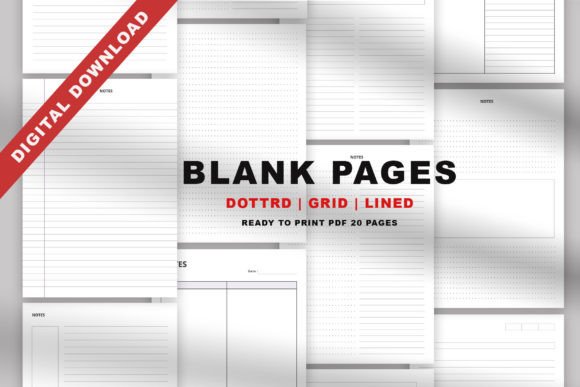
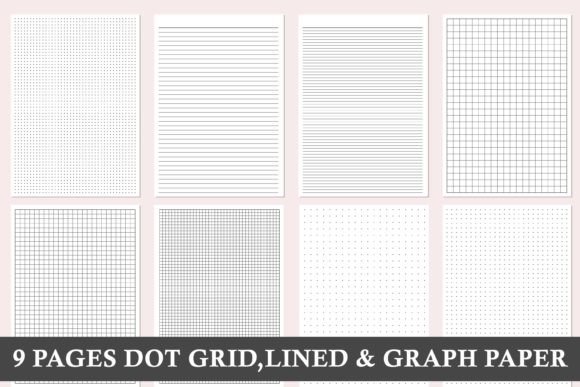
When you look at a typical printable insert template collection, you often find all three formats bundled together. A single set might include lined 5mm, 7.5mm, and 10mm spacing, graph 5mm, 7.5mm, and 10mm spacing, and dotted grid 5mm, 7.5mm, and 10mm spacing. This variety allows you to mix and match pages according to the task. For example, you might use a narrow 5mm dotted grid for a weekly planner spread, a 7.5mm lined page for meeting notes, and a 5mm graph page for a project timeline. Having all options in one notebook or binder means you never have to compromise on the format that works best for a particular job.
Practical Considerations: Spacing, Printing, and Modern Workflows
Choosing between these templates involves more than just personal preference. The spacing of the lines, dots, or grid cells directly affects how much information fits on a page and how comfortable the writing experience feels. Smaller spacing (5mm) is excellent for detailed diagrams, compact handwriting, or languages with small characters. Larger spacing (7.5mm to 10mm) suits larger handwriting, young writers, or tasks where you need to add annotations, corrections, or doodles in the margins. Many people find that 7.5mm hits a sweet spot for general note-taking, offering enough room for legibility without wasting vertical space.
In the age of digital note-taking and hybrid workflows, printable templates have gained tremendous popularity. A printable insert template allows you to generate exactly the paper you need, whether for a disc-bound planner, a ring binder, or a standalone refill pad. You can download a PDF containing multiple page styles and print only the ones you actually use. This eliminates the waste of buying a whole notebook when you only need a few pages of a specific grid pattern. For designers and students who work with both analog and digital tools, having a library of Dotted Grid Paper Template, Lined Paper, and graph pages stored on a computer means you can always produce the perfect page on demand.
Another factor to consider is ink bleed and paper weight. When using a printable template, the quality of the paper you print on matters just as much as the design. Heavier paper (70–100 gsm) prevents ink from bleeding through to the other side, which is crucial when you are using fountain pens, markers, or gel pens. Lighter paper may be fine for pencil or ballpoint, but for serious note-taking and drawing, investing in good quality paper makes the template truly effective. Many printable sets are designed for A4, letter, or half-size formats, so check your printer settings and binding method before committing to a layout.
In modern workflows, people rarely stick to a single format. A student might use Lined Paper for literature notes, graph paper for math problem sets, and a dotted grid for planning study schedules. A creative professional might keep a notebook with all three templates, switching between them as the project evolves. This flexibility is why collections that include 1 version with multiple spacings are so popular. They acknowledge that no single template works for every task, and they give you the freedom to adapt your paper to your thinking style rather than the other way around.
Ultimately, the best paper template is the one that disappears into your workflow — you do not fight the lines, the dots, or the grid; they simply support your work. Whether you prefer the familiar structure of lined paper, the subtle guidance of a dotted grid, or the precision of graph paper, having access to all three in the spacings you need ensures that your printable notes, sketches, and plans look clean, organized, and professional. The next time you sit down to plan a project, practice calligraphy, or take meeting notes, consider which template aligns with the task. A small change in the pattern beneath your pen can make a surprisingly large difference in how effectively you capture and communicate ideas.