Bringing Cottagecore Charm to KDP: A Deep Dive into Vintage Composition Notebook Covers
The low-content book market on Amazon KDP continues to reward creators who pair solid content strategy with distinctive visual presentation. Among the most popular niches are composition notebooks, which offer a blank canvas for journaling, sketching, note-taking, and planning. But the difference between a notebook that sells and one that languishes often comes down to the cover. This is where a well-curated bundle like the 50 Vintage Composition Notebook Covers becomes a practical asset for any KDP publisher. This collection blends the nostalgic appeal of vintage design with the current popularity of cottagecore aesthetics, giving sellers a versatile toolkit for reaching a wide audience.
What the Bundle Delivers: Templates, Files, and Flexibility
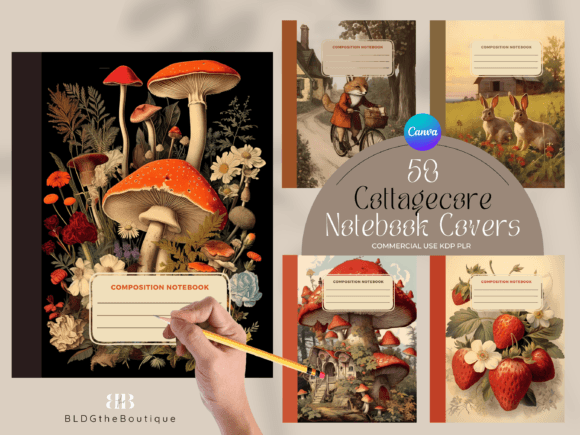
When you purchase this bundle, you are not simply getting static images. You receive a complete set of assets designed to streamline your production workflow. The core of the package is a collection of 50 distinct cover designs, each rendered as a high-resolution JPG file at 300 dpi. The dimensions of these files are 12.3 inches by 16.4 inches, providing ample resolution for a sharp, professional print. Beyond the JPGs, the bundle includes fully editable Canva templates that are pre-formatted for a standard 7.5-inch by 9.25-inch composition notebook with 110 pages. This means the front cover, back cover, and spine are already laid out correctly. You can adjust the label color, label font, and spine color directly within Canva, giving you control over key visual elements without needing advanced design software. The templates can also be resized and exported as a PDF for direct upload to KDP, which simplifies the final steps of listing creation.
The Importance of Editable Label and Spine Elements
One of the biggest hurdles in selling low-content books is making each listing feel unique while maintaining a cohesive brand. The ability to modify the label color and font on these vintage composition notebook covers is a subtle but powerful feature. You can swap a delicate serif font for a bolder sans-serif depending on whether you are targeting a writer who prefers classic elegance or a student who needs a more readable, modern look. Similarly, adjusting the spine color allows you to create series that stand out as a set on a bookshelf or in Amazon search results. This level of customization means you are not locked into a single style for every cover. You can test different label treatments to see which resonates best with your audience, all using the same underlying vintage artwork.
Who Benefits from These Vintage Composition Notebook Covers
The versatility of this bundle makes it relevant for several types of creators and business owners within the KDP ecosystem. Understanding your own role in this process helps you apply the assets more effectively.
- New KDP Publishers: If you are just starting out, sourcing 50 unique, print-ready covers at once removes a major bottleneck. You can focus on learning the KDP interface, pricing strategies, and keyword research while having a batch of professional covers ready to go.
- Experienced Low-Content Sellers: For those who already have a catalog, this bundle offers a way to quickly expand into the vintage or cottagecore niche. The 300 dpi JPGs and Canva templates mean you can batch-produce new listings in a single afternoon, testing which designs attract the most traffic.
- Hobbyists and Creators: Even if you do not sell on Amazon, these covers work for personal projects. You might create custom notebooks for a craft fair, a small Etsy shop, or gifts for friends who appreciate rustic, old-fashioned aesthetics. The commercial use resell rights included in the purchase allow for this flexibility.
- Small Business Owners: Boutique stationery brands or online shops that sell printed notebooks can use these templates as a starting point for their own product lines. The ability to resize the Canva templates means you are not restricted to the standard 7.5 x 9.25 format; you can adapt them for pocket notebooks, spiral-bound journals, or even hardcover planners.
Real-World Use Cases for a Vintage Notebook Bundle
Practical application of these covers goes beyond simply uploading a file to KDP. The design style itself—vintage, cottagecore, rustic—naturally aligns with specific content types and audience expectations. Here are several ways you can deploy these covers effectively.
Journaling and Diary Notebooks
The cottagecore trend emphasizes a return to simpler, slower living. A cover with faded florals, aged paper textures, or old-fashioned typography immediately signals that the notebook inside is meant for reflective journaling, gratitude lists, or daily diary entries. When paired with interior pages that include lined paper or dot grids, the vintage composition notebook covers create a cohesive product that feels both intentional and inviting. Buyers searching for aesthetic journals often prioritize cover design as much as paper quality, making this a strong niche for conversion.
Recipe and Kitchen Notebooks
Vintage aesthetics lend themselves naturally to food and homekeeping themes. A composition notebook with an antique label and a faded botanical illustration can be marketed as a recipe book, a kitchen journal, or a garden planner. The editable label feature is particularly useful here: you can customize the text to say "Family Recipes," "Preserves & Pickles," or "Harvest Notes." This specificity helps your listing rank for long-tail keywords like "cottagecore recipe journal" or "vintage kitchen notebook."
Student and Classroom Use
Not all vintage covers are purely decorative. Some of the designs in this bundle use muted, scholarly colors and classic patterns that appeal to students and teachers. By adjusting the label font to something clean and readable, you can create notebooks suitable for class notes, research journals, or lab books. The standard 7.5 x 9.25 size is already common in classrooms, and the vintage look adds a touch of personality without being distracting.
Gift and Stationery Sets
Because the bundle includes 50 covers, you can create coordinated sets of notebooks for sale on KDP or other platforms. A set of three notebooks with matching covers but different label colors (for example, one for to-do lists, one for journaling, and one for sketching) makes an attractive gift package. The commercial resell rights allow you to market these sets directly to customers, or you can list them as individual products on Amazon and cross-link them in your catalog.
Design Considerations and Customization Workflow
Getting the most out of these vintage composition notebook covers requires a basic understanding of how to work within Canva and how to prepare files for KDP. The workflow is straightforward, but attention to detail matters.
- Access the Templates: After purchase, you will receive a link to the Canva templates. You need a free Canva account to open and edit them. The templates are already formatted for a 110-page, 7.5 x 9.25 notebook, including bleed margins and spine width.
- Customize Label and Spine: Within Canva, locate the editable text layers on the cover label and spine. Change the font, size, and color to match your branding or the specific theme of the notebook. You can also adjust the background color of the label for additional variation.
- Resize if Needed: If you want to publish a different trim size (such as 6 x 9 or 8.5 x 11), use Canva's resize feature. Keep in mind that changing the size will also require adjusting the spine width based on your page count. The 300 dpi JPG files provide enough resolution to scale down without quality loss.
- Export for KDP: Once your design is finalized, export the file as a PDF Print. Use the "flatten PDF" option in Canva to ensure all elements are embedded. Upload this PDF to KDP as your cover, and pair it with your interior file.
- Test a Sample: Before listing all 50 covers, consider publishing one or two to gather feedback. Monitor your conversion rate and see if the vintage aesthetic resonates with your target keywords. You can then refine your label and spine choices for the remaining designs.
Commercial Use and Resell Rights Explained
A key factor for many KDP sellers is understanding what they can and cannot do with the assets they purchase. The 50 Vintage Composition Notebook Covers bundle includes commercial use resell rights. This means you are allowed to use these covers to create and sell low-content books on Amazon and other platforms. You can modify the designs, combine them with your own interior pages, and sell the finished notebooks as your own products. However, the files themselves are not unique to you—they will be sold to other creators. This is standard for design bundles in the KDP space. You are paying for the convenience of having 50 pre-made, editable templates that save you hours of design work, rather than for an exclusive, one-of-a-kind cover. If you need true exclusivity, you would commission custom artwork. But for most publishers, the ability to customize the label and spine provides enough differentiation across the marketplace.
What You Do Not Get
It is also worth noting what is not included. These are not SVG or vector files, so you cannot infinitely scale them without losing quality. However, at 300 dpi and 12.3 x 16.4 inches, they are more than adequate for typical KDP notebook sizes. No physical items are shipped with this order; everything is delivered as digital downloads. You are responsible for creating your own interior pages, though many KDP sellers use free or paid tools like Canva, Adobe InDesign, or Kindle Create for that purpose.
Practical Tips for Selling Vintage Composition Notebooks on KDP
Having the covers is only half the equation. To succeed in the low-content book market, you need to pair strong visuals with smart listing optimization and consistent effort.
- Keyword Research: Use tools like Helium 10, Publisher Rocket, or even Amazon's own search bar to find phrases related to vintage notebooks, cottagecore journals, and composition books. Incorporate those keywords into your title, subtitle, and book description.
- Category Selection: Choose the most specific category possible for your notebook. General categories like "Books" are too competitive. Look for subcategories like "Vintage & Antique Journals" or "Cottagecore Notebooks" if they exist, or create a close match.
- Cover Variation: Since you have 50 designs, do not upload them all at once. Stagger your releases so that you can gauge which styles perform best. Test different label fonts and spine colors to see what drives clicks.
- Interior Consistency: The cover sets a promise about the interior. A vintage cover should pair with simple, clean interior pages. Avoid overly modern or cluttered layouts inside. Lined paper, dot grids, or blank pages with subtle aged backgrounds work well.
- Pricing Strategy: Composition notebooks on KDP typically sell between $5.99 and $9.99 depending on page count and perceived value. Consider running a promotional price for your first few listings to build reviews and sales velocity.
Final Observations on the Vintage Notebook Niche
The appeal of vintage design goes beyond simple nostalgia. In a digital age, physical notebooks with old-fashioned covers offer a tactile, analog experience that many people crave. The cottagecore movement has only intensified this desire for objects that feel handmade, historical, or connected to nature. By using the 50 Vintage Composition Notebook Covers, you are tapping into a well-established aesthetic that resonates with journalers, students, artists, and anyone seeking a slower, more intentional way to record their thoughts. The editable label and spine features give you the flexibility to adapt these designs to different audiences and product types, while the pre-formatted templates reduce the technical friction of getting your book listed. Whether you are launching your first KDP product or expanding an existing catalog, this bundle provides a strong foundation for building a series of notebooks that stand out in a crowded marketplace.