Why a Dream Journal Matters and How My First Dream Journal Unlocks the Practice for All Ages
The practice of recording dreams is as ancient as storytelling itself, yet it remains one of the most underutilized tools for self-discovery, creativity, and mental clarity in the modern world. For many, the idea of keeping a dream journal feels either too mystical, too time-consuming, or simply unnecessary. Yet, the moment you begin capturing those fleeting fragments of the night, a pattern emerges—one that reveals hidden fears, untapped creative ideas, and emotional threads that weave through waking life. My First Dream Journal is not just another notebook; it is a deliberately crafted tool designed to make this practice accessible, structured, and deeply personal for users of all ages, from young children just beginning to articulate their inner world to adults seeking clarity and creators mining for inspiration.
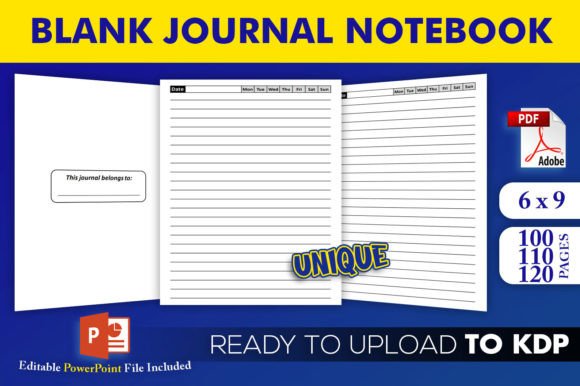
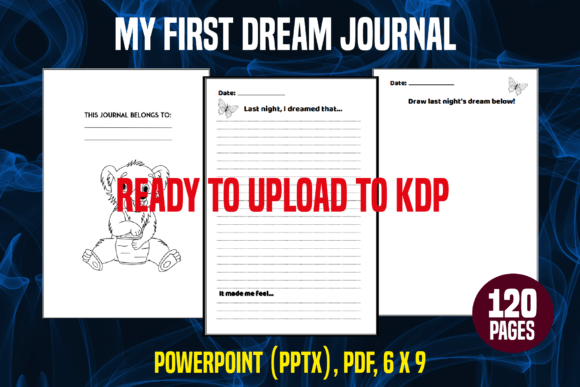
What sets this particular journal apart is the combination of thoughtful design and practical flexibility. The product, available as an editable PowerPoint PPTX file alongside a print-ready PDF interior, offers a rare degree of customization that traditional bound journals simply cannot match. With 120 pages housed in a trim size of 6 x 9 inches, it strikes a balance between portability and ample space for writing, sketching, or collaging dream fragments. The high-resolution interior ensures that every line, illustration, and prompt prints with crisp clarity whether you produce it at home or upload it directly to KDP for distribution. This means a parent can tailor the journal for their child by removing or adding prompts, a teacher can adapt it for a classroom project, or an entrepreneur can rebrand it entirely under their own publishing imprint.
The Real-World Relevance of Dream Journaling Across Audiences
Dream journaling is not a niche hobby reserved for psychoanalysts or spiritual seekers. It has tangible relevance across a broad spectrum of human activity. For professionals, particularly those in high-stress fields such as healthcare, law, or executive management, dreams often process unresolved tensions and provide fresh perspectives on complex problems. A consistent journaling habit can surface recurring themes that point to burnout before it fully manifests, or illuminate a creative solution that the conscious mind overlooked during the day. My First Dream Journal provides the structured space needed to capture these insights before they evaporate upon waking, using prompts that guide the user toward identifying emotional tones, symbols, and narrative arcs rather than simply listing random events.
For educators and parents, the journal becomes a bridge between the abstract world of a child's imagination and their developing language skills. Children frequently experience vivid dreams but lack the vocabulary or confidence to describe them. By offering a dedicated, playful format—complete with room for drawings and simple checkboxes about how the dream made them feel—the journal encourages emotional literacy and narrative thinking. A child who learns to record their dreams also learns to pay attention to detail, to sequence events, and to reflect on cause and effect. These are foundational skills that extend far beyond sleep. The editable PPTX format allows a parent or teacher to simplify the prompts further or even translate them into another language, making the tool truly inclusive.
Hobbyists and creators—writers, painters, musicians, game designers, and filmmakers—have long known that the dream state is a wellspring of original material. Salvador Dalí, Mary Shelley, and Paul McCartney all famously drew inspiration from their dreams. However, the challenge is that dreams are notoriously ephemeral. You might recall a stunning landscape or a bizarre conversation at breakfast, but by lunchtime the details have dissolved. The high-resolution interior of My First Dream Journal is designed to be kept beside the bed, ready for that groggy, half-awake moment of scribbling. Its 120 pages provide enough room for months of consistent recording, and the 6 x 9 size fits comfortably on a nightstand or in a travel bag. Over time, the journal becomes a personal archive of raw creative material that can be mined for projects, characters, plot twists, or visual motifs.
Flexible Formats for Different Workflows
Understanding the practical needs of different users is central to the design of this product. The two-file system—an editable PowerPoint PPTX source file and a ready-to-use PDF interior—acknowledges that not everyone works the same way. A business owner who wants to publish the journal under their own brand on KDP can open the PPTX, swap in their logo, adjust the color palette, and modify prompts to suit their target audience. This is a significant advantage over purchasing a locked template that cannot be customized. The PDF file, by contrast, is optimized for those who simply want to print and go. It has been tested to meet KDP upload specifications, meaning there is no guesswork regarding bleed margins, trim lines, or resolution requirements. This eliminates a major headache for first-time self-publishers who may be unfamiliar with print-ready formatting.
The 120-page count is worth examining in more detail. A common problem with many dream journals on the market is that they either contain too few pages, making them seem insubstantial, or too many, which can feel intimidating to a beginner. One hundred twenty pages is a sweet spot. For a daily journaler, this provides roughly four months of entries. For someone who writes three times a week, it stretches closer to nine months. This duration is important because dream journaling yields its most profound benefits over time. Patterns in dream content—frequent falling dreams, recurring locations, or repeated interactions with certain people—only become visible after weeks or months of consistent recording. Having enough pages to sustain that practice without interruption is a deliberate design choice that supports long-term engagement rather than short-term novelty.
Observations on User Behavior and the Journaling Experience
One of the more subtle aspects of dream journaling is that the very act of writing changes how we dream. Users often report that after a few weeks of regular recording, their dreams become more vivid, more structured, and easier to recall. This is not a mystical effect but a neurological one. By signaling to the brain that dreams are important enough to document, we heighten our awareness during the sleep cycle itself. The presence of a dedicated journal like My First Dream Journal reinforces this feedback loop. Its physical existence on the nightstand serves as a visual cue that primes the mind to pay attention. Users who keep the journal in a consistent place—rather than buried in a drawer or left in another room—consistently report higher recall rates and richer detail in their entries.
Another observation worth highlighting is the range of entry styles that emerge. Some users fill pages with dense paragraphs of narrative prose. Others draw elaborate diagrams or maps of dream landscapes. Still others prefer bullet points, keywords, or even single words accompanied by color swatches. The open-ended design of the journal accommodates all these approaches without imposing a rigid structure. The prompts are suggestive rather than prescriptive, asking questions like "What was the strongest emotion in this dream?" or "Were there any numbers, colors, or symbols that stood out?" This flexibility is particularly valuable for classroom or therapy settings where individuals may have different expressive strengths. A child who struggles with writing may produce a rich entry through drawing alone, and the journal's layout provides space for both modes of expression on the same page.
Considerations for Different Use Cases
For those considering using My First Dream Journal in a professional context—such as a therapist recommending it to clients or a coach incorporating it into a wellness program—the editable PPTX file is a major asset. You can tailor the language to match your clinical or coaching framework. For example, a cognitive behavioral therapist might add prompts that link dream content to specific thought patterns, while a narrative coach might focus on story arcs and character roles within the dream. This level of adaptability means the journal is not a one-size-fits-all product but a scaffold that can be built upon. It also means that a practitioner can produce a branded version for their clients, reinforcing their professional identity while providing a useful tool.
Business owners and entrepreneurs looking at the KDP market will appreciate that the product has already been vetted for print-on-demand compliance. The interior is high-resolution, the trim size is standard, and the page count falls within a profitable production range. Many self-publishers struggle with the technical aspects of interior formatting—margins that shift, images that lose resolution, or fonts that do not embed properly. This product removes those barriers. The PDF can be uploaded directly without additional manipulation, and the PPTX file allows for rebranding or minor layout adjustments without requiring advanced design software. This lowers the barrier to entry for anyone who wants to test the dream journal niche without investing hundreds of dollars in custom design work.
The Broader Context of Dream Journaling in the Digital Age
In an era where most of our personal documentation occurs on screens—notes apps, voice memos, social media—there is something irreplaceable about a physical journal dedicated to the unconscious mind. The act of handwriting has been shown to improve memory retention and emotional processing compared to typing, and the private, non-digital nature of a dream journal offers a respite from the constant connectivity of modern life. However, the editable PPTX format acknowledges that some users do want a digital component, whether to print new pages as needed or to share their entries with a therapist or journaling group. The dual-format approach respects both preferences rather than forcing a single workflow.
Educators have also found creative applications for dream journals in subjects ranging from creative writing to psychology to art. A high school teacher running a unit on surrealism, for example, can ask students to record their dreams for two weeks and then use the entries as source material for a painting or short story. The 6 x 9 trim size makes the journal easy to store in a classroom bin or backpack without taking up excessive space. The 120 pages ensure that even if students miss a few nights, they have enough room to complete the assignment without running out of space. For homeschooling parents, the journal can be integrated into a broader curriculum on self-awareness, storytelling, or even science—discussing the neurology of sleep and dreaming alongside the journaling practice.
Practical Usability and Long-Term Value
A final point of practical consideration is how the journal holds up to repeated use. The high-resolution interior is printed on quality stock that resists bleed-through from pens, markers, or light watercolor washes. This matters because dream journaling often happens in low light, and users may grab whatever writing instrument is closest. The pages are designed to withstand that lack of precision. The 6 x 9 trim size also allows for enough margin space that users can add notes or highlights without crowding the central writing area. Over months of use, a filled journal becomes a time capsule of inner life—a document that can be revisited years later to see how dreams changed during a particular job, relationship, or personal challenge. This long-term value is something that digital notes, which are often deleted or lost in a sea of files, cannot replicate.
Whether you are a parent looking to give your child a gentle introduction to self-reflection, a creator seeking an organized way to harvest dream imagery, a therapist expanding your toolkit, or an entrepreneur publishing under your own brand, My First Dream Journal offers a practical, adaptable foundation. The combination of editable and print-ready formats, the tested KDP compatibility, and the carefully considered page count and trim size make it a versatile resource that serves both the beginner and the experienced practitioner. The most effective tools are those that fade into the background, allowing the practice itself to take center stage. This journal does exactly that—it provides structure without rigidity, space without waste, and flexibility without complexity.