Letters to My Daughter. Journal: A Strategic Tool for Legacy, Reflection, and Intentional Communication
Most journals ask you to write about your day. Some prompt you to explore your feelings. A rare few ask you to write to someone who matters. Letters to My Daughter. Journal sits in that last category. It is not a diary of events. It is a deliberate practice of communication, legacy, and emotional precision. For anyone who has ever wanted to say something important to a daughter but struggled to find the right moment or the right words, this journal offers a structured path forward.
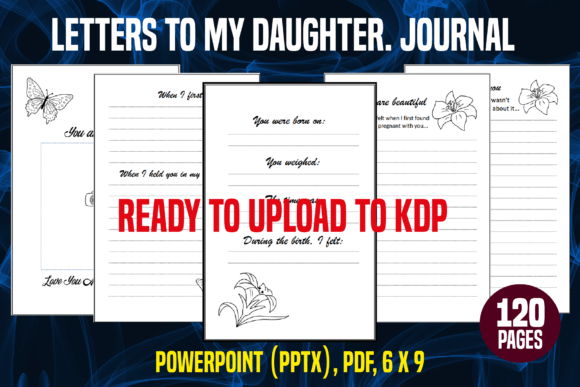
The format is straightforward: 120 pages, a trim size of 8.25 x 6 inches, with high-resolution interiors that make the act of writing feel intentional rather than haphazard. It comes as both a PDF interior ready for upload to KDP or print and an editable PowerPoint PPTX source file. That means it can be used as a personal journal, as a published product for others, or as a template to adapt for specific relationships and contexts. But the real value is not in the file format. It is in what the journal asks you to do: write letters to your daughter, over time, with purpose.
Why a Structured Letter Journal Supports Long-Term Goals
Writing a letter to a daughter is not a casual act. It requires thought, memory, and a clear sense of what you want to convey. Without a structure, most people postpone it indefinitely. The journal removes that friction. It gives you a container, a sequence, and a reason to sit down and write. Over weeks and months, those individual letters become a body of work that documents not just what happened, but what you believed, valued, and hoped for.
This has real strategic value for several reasons. First, it forces clarity. When you write to someone you care about, you edit your thoughts. You choose what matters. You discard the trivial. That discipline of selection improves how you think about your own life and priorities. Second, it creates a record that compounds. A single letter is a moment. Thirty letters are a narrative. The journal transforms scattered intentions into a coherent story that a daughter can return to at any age.
For entrepreneurs, creators, and professionals, this kind of structured reflection is not separate from your work. It is adjacent to it. The same mental habits that help you write a clear letter to a daughter help you write a clear proposal, a better email, or a more focused strategy. The journal trains you in precision, empathy, and long-term thinking. Those skills transfer directly to how you communicate with clients, teams, and audiences.
How to Approach the Journal with Intention
The biggest mistake people make with any guided journal is treating it as a fill-in-the-blank exercise. You answer the prompt, close the book, and move on. That approach produces shallow results. The better way is to treat each letter as a small project. Before you write, spend a few minutes thinking about what you actually want to say. What does your daughter need to hear right now? What do you need to say, even if it is uncomfortable? The journal is a safe place for both.
Here is a practical way to approach it:
- Set a recurring time. Pick a day of the week or month. Put it on your calendar. Treat it the way you would treat a meeting you cannot cancel. Consistency matters more than length. A short letter written regularly will outlast a long letter written once.
- Write first, edit later. Do not try to make it perfect in one pass. Get the thoughts down. Let them be rough. You can refine the language after the meaning is clear.
- Read previous letters before writing a new one. This creates continuity. You will notice themes, see how your thinking has evolved, and avoid repeating yourself unnecessarily.
- Be specific. General sentiments like "I love you" are important, but they land harder when attached to a specific memory or observation. The journal works best when you ground it in real moments.
If you are publishing the journal for others, the same principles apply to how you position it. The value is not in the number of pages. It is in the quality of the prompts and the space they create. A well-designed journal respects the reader's time and emotional energy. It gives them a framework without telling them what to feel.
Practical Use Cases for Different Contexts
The journal is not limited to one type of relationship or one stage of life. It adapts to different needs, and that flexibility is part of its strategic usefulness. Consider these scenarios:
For a parent with a young daughter
You are writing letters she cannot fully read yet. That is fine. The letters become a time capsule. You describe her at this age, the things she says, the way she laughs, the challenges you face together. When she is older, these letters will be a gift that no photograph can match. The journal helps you capture what you would otherwise forget.
For a parent of a teenage or adult daughter
The relationship has history. There might be things left unsaid, apologies that never landed, or pride that never got voiced. The journal gives you a structured way to address those gaps. You are not trying to control the relationship. You are simply putting your piece into the conversation. That act alone can shift the dynamic, even if the daughter never responds the way you hope.
For a mentor, coach, or educator
The journal is not limited to biological family. A daughter can be a mentee, a student, a younger colleague, or a family friend. The same principles apply. You are writing to someone you want to guide, encourage, or challenge. The journal format legitimizes that effort and gives it a permanent form.
For a publisher or creator
If you are in the business of producing journals or guided content, the editable source file is a practical advantage. You can modify the prompts, adjust the design, and create variations for different audiences. The high-resolution interior ensures that the final product looks professional on Amazon or in print. The 120-page count is a standard length that feels substantial without being overwhelming. This is a product that can be taken to market quickly with minimal additional work.
What to Consider Before You Rely on the Journal
No tool works by itself. The journal is a framework, not a solution. If you use it without clear goals, it will produce generic content that neither you nor your daughter will value. The risk is that you treat the act of writing as the outcome, when in reality the outcome is the relationship itself. The journal is a means to an end. Keep the end in mind.
Here are a few things to consider before you start:
- Clarify your intent. Are you writing to preserve memories, to heal a relationship, to leave a legacy, or simply to practice writing? Your intent shapes everything else. If you do not know why you are writing, the letters will feel aimless.
- Be honest about time. A 120-page journal with regular entries takes commitment. If you cannot sustain the pace, scale back. Write once a month instead of once a week. The goal is completion, not speed.
- Accept imperfection. Some letters will be better than others. Some will feel awkward or sentimental. That is part of the process. Do not abandon the journal because one entry did not meet your standard. Keep going.
- Consider the reader. If your daughter is old enough to read, ask yourself how she will receive these letters. Will they feel like pressure or like a gift? The tone matters. The journal can be a bridge or a wall, depending on how you use it.
Possible Risks of Using the Journal Without Clear Context
There is a real downside to using any guided journal without thoughtfulness. The first risk is performative writing. You fill the pages because you feel you should, not because you have something to say. The result is empty content that takes up space but carries no weight. That is a waste of your time and the reader's.
The second risk is emotional dumping. A journal is not a therapist. If you use it to vent unresolved anger or grief without any attempt at reflection, you may damage the relationship rather than strengthen it. The journal is not a place to unload. It is a place to process, to distill, and to offer. Keep that distinction clear.
The third risk is over-reliance on the format. The journal is a starting point, not the entire relationship. If you write beautiful letters but never speak directly to your daughter, you have substituted writing for living. The best use of the journal is as a supplement to real conversations, not a replacement for them.
Using the Journal as a Decision-Making Tool
This may sound counterintuitive. A journal about letters does not seem like a decision-making tool. But writing a letter forces you to take a position. You cannot be vague when you are addressing someone directly. You have to decide what you believe, what you want to say, and how you want to say it. That process is clarifying.
If you are facing a difficult decision about a relationship, a career move, or a personal change, try writing a letter to your daughter about it. Explain the situation as if she were old enough to understand. You will quickly discover what you actually think and feel. The journal becomes a rehearsal for real decisions, a place to test your reasoning before you act.
For publishers and creators, this same clarity applies to product decisions. When you design a journal, you are deciding what prompts to include, what tone to set, and what experience to deliver. Every choice communicates something to the end user. The editable source file gives you the freedom to iterate on those choices until they align with your vision.
Long-Term Value and Cumulative Impact
The real value of Letters to My Daughter. Journal is not in any single letter. It is in the accumulated effect of writing over time. A single letter might be forgotten. A collection of letters, written over months or years, becomes a reference point for an entire relationship. It documents growth, change, and continuity. It shows a daughter that someone thought about her, consistently, over time. That message is more powerful than any single sentiment.
From a publishing perspective, the long-term value is equally clear. A well-crafted journal with universal appeal can sell for years. It does not depend on trends. It meets a basic human need: the desire to communicate meaningfully with someone we love. The high-resolution interior and standard trim size mean the product looks professional on a shelf or in an Amazon listing. The editable format means you can adapt it to other relationships, other audiences, and other markets without starting from scratch.
The journal is not complicated. It is 120 pages, a set of prompts, and a structure. But structure is what turns intention into action. If you want to write to your daughter, this journal removes the barrier. If you want to publish a journal that helps others do the same, this template gives you a head start. Either way, the work begins when you sit down and write. The journal simply makes it easier to begin.