Kids Coping Skills Journal: Tools for Emotional Growth
Helping children understand and manage their emotions is one of the most meaningful investments you can make in their future. A Kids Coping Skills Journal provides a structured yet flexible way for children to explore feelings, practice grounding techniques, and build resilience. Whether you are a parent looking for at-home activities, a teacher seeking classroom resources, a therapist building a toolkit, or a creator preparing content for Amazon KDP, this journal offers something valuable for every situation.
What Is a Kids Coping Skills Journal?
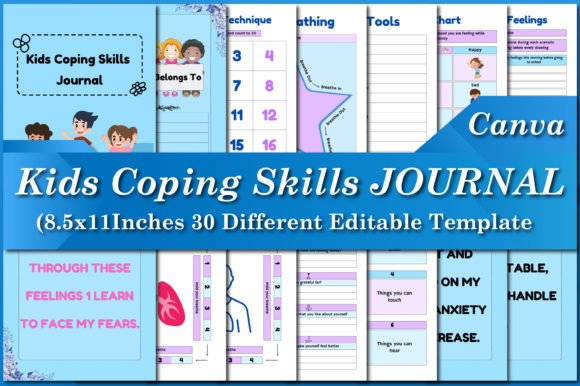
At its core, a Kids Coping Skills Journal is a collection of worksheets, prompts, and exercises designed to help children identify emotions, develop self-regulation strategies, and practice mindfulness. The version I am referring to includes templates for grounding techniques, star breathing, mood charts, check-in pages, growth mindset exercises, self-care checklists, and more. Each page serves a specific purpose, from helping a child name what they feel to guiding them through a mindful minute or a square breathing exercise.
What makes this particular journal stand out is that it comes as a print-ready PDF with an editable Canva link. That means you can use it exactly as designed or customize it to fit your child, your classroom, or your brand. The files are formatted for Amazon KDP at 8.5 by 11 inches with CMYK color and 300 DPI, so the quality holds up both in print and on screen.
Parents and Caregivers Looking for Practical Tools
If you are a parent, you already know that kids do not always have the words to say what they are feeling. A mood chart or a "Today I Feel" page gives them a safe way to point, draw, or write what is going on inside. The grounding technique page helps them anchor themselves when they feel overwhelmed, and the star breathing exercise turns a big feeling into something manageable. For you, the value lies in ease of use. You do not need any training or extra materials. Just print a page, sit with your child, and follow along. The journal becomes a shared activity that opens conversations without pressure.
Many parents also appreciate that the journal is reusable. Because it comes with an editable Canva link, you can print fresh copies whenever needed, or tweak the wording to match your child's age or interests. That flexibility matters when you have more than one child or when your child's needs change over time.
Educators and School Counselors Seeking Structured Resources
For teachers and school counselors, consistency and reliability are key. You need resources that work across different age groups and that align with social-emotional learning goals. The "Check In" page and the "Things I Can Control" worksheet fit naturally into morning meetings or one-on-one check-ins. The growth mindset worksheet helps students reframe challenges, and the "What Did You Learn Today" page encourages reflection without feeling like another assignment.
The print-ready PDF format is a practical advantage here. You can print a class set in minutes, and because the dimensions are standard, they fit into binders or folders easily. The high-quality 300 DPI resolution means the worksheets look clean and professional, whether you print in color or black and white. If you need to adjust the language for different grade levels, the editable Canva link gives you that control without starting from scratch.
Therapists and Mental Health Professionals
If you work with children in a clinical or counseling setting, you know that every child responds differently. Some need visual cues. Others need a physical activity like breathing or drawing. This journal covers both. The "Draw Your Feelings" page offers a non-verbal outlet, while the "Control Anger" worksheet provides a step-by-step framework for managing strong emotions. The "Mindful Minute" exercise works well as a warm-up or closing activity for sessions.
Professionals often prioritize quality and flexibility over cost. Knowing that the journal is print-ready and editable means you can adapt it for telehealth sessions, send pages home with families, or build a binder of resources tailored to each client. The no-bleed format and CMYK color profile also mean that if you choose to have copies professionally printed, they will look polished and credible.
Content Creators, Entrepreneurs, and KDP Publishers
This is where the journal takes on a different kind of value. If you are a creator or small business owner selling on Amazon KDP, the Kids Coping Skills Journal is essentially a product you can upload and publish with minimal effort. The files are already tested on KDP, formatted with no bleed, and set to the correct color profile. That saves you hours of formatting and technical troubleshooting.
The included templates checklist covers popular niches: coping skills, mindfulness, growth mindset, self-care, and emotional check-ins. These are all high-demand categories in the children's activity book space. Because you also receive an editable Canva link, you can rebrand the journal with your own cover, change the title, adjust the language, or add your logo. That customization turns a single resource into multiple product variations. For someone building a publishing business, that is a meaningful time saver and a way to expand your catalog quickly without sacrificing quality.
Understanding the Templates and What They Offer
Let me walk through a few of the included templates so you can see how they serve different needs.
Grounding Technique and Star Breathing
These two pages are among the most practical tools in the journal. The grounding technique helps a child connect with the present moment by focusing on sensory input. The star breathing exercise uses a visual shape to guide inhale and exhale patterns. Both are simple enough for a young child but effective enough that adults often use similar techniques themselves.
Mood Chart and Check In
The mood chart gives a visual snapshot of how a child is feeling over time. The check-in page is more immediate, asking how they are right now and what they might need. Together, they provide both the big picture and the daily moment.
Growth Mindset and Fixed Mindset Worksheet
This worksheet helps children recognize the difference between a growth mindset and a fixed mindset. It presents common scenarios and asks the child to identify which mindset they are using. It is a concrete way to teach resilience and self-awareness.
Self-Care Checklist and Things I Can Control
These two pages reinforce the idea that children have agency over their own well-being. The self-care checklist lists simple actions they can take, while "Things I Can Control" helps them focus on what is within their power instead of worrying about what is not.
Mindful Minute and What Did You Learn Today
The mindful minute is a short, guided reflection that works well as a transition activity. "What Did You Learn Today" shifts the focus to growth and curiosity, which supports both academic learning and emotional development.
Who Should Choose This Journal?
This journal is a good fit if you value practicality and quality. It is not a generic coloring book with a few scattered activities. Each page has a clear purpose, and the combination of printable PDF plus editable template gives you control without requiring design skills.
If you are a beginner—whether as a parent new to coping strategies or a publisher new to KDP—the ready-to-upload format removes a lot of guesswork. You do not need to worry about margins, bleed, or color profiles. If you are experienced, you will appreciate the flexibility of the Canva link. You can remix the pages, change fonts, or add your own content while keeping the structure that works.
For professionals and educators, the journal earns its place because it is evidence-informed. The techniques like grounding, breathing, and check-ins are widely used in therapeutic and educational settings. The journal does not try to replace professional guidance, but it does provide tools that reinforce the skills taught in sessions or classrooms.
Quality, Cost, and Long-Term Use
Quality shows in the details. The 300 DPI resolution ensures that lines print sharply and colors remain consistent. The CMYK color profile is industry standard for print, which matters if you intend to sell physical copies. The 8.5 by 11 inch size leaves enough room for children to write and draw without feeling cramped.
Cost is relative to how you plan to use it. For a parent printing a few pages at home, the value is in the content and the ability to reprint as needed. For a publisher, the cost per page is negligible compared to the time saved in formatting and design. The editable Canva link adds ongoing value because the journal is not a one-time resource. You can update it, repurpose it, or adapt it for different audiences over months or years.
Final Thoughts on Practical Fit
A Kids Coping Skills Journal works best when it matches the way you or your child actually use it. If you need something quick and ready, the print-ready PDF delivers. If you want to make it your own, the Canva template gives you that freedom. The 30 pages cover a wide range of needs without overwhelming the user, and the format is tested for both home printing and commercial publication.
Whether you are helping one child find calm after a tough day, building a classroom routine around emotional check-ins, or launching a new KDP title in a growing niche, this journal provides a solid foundation. The tools inside are simple enough to use today and sturdy enough to return to again and again.